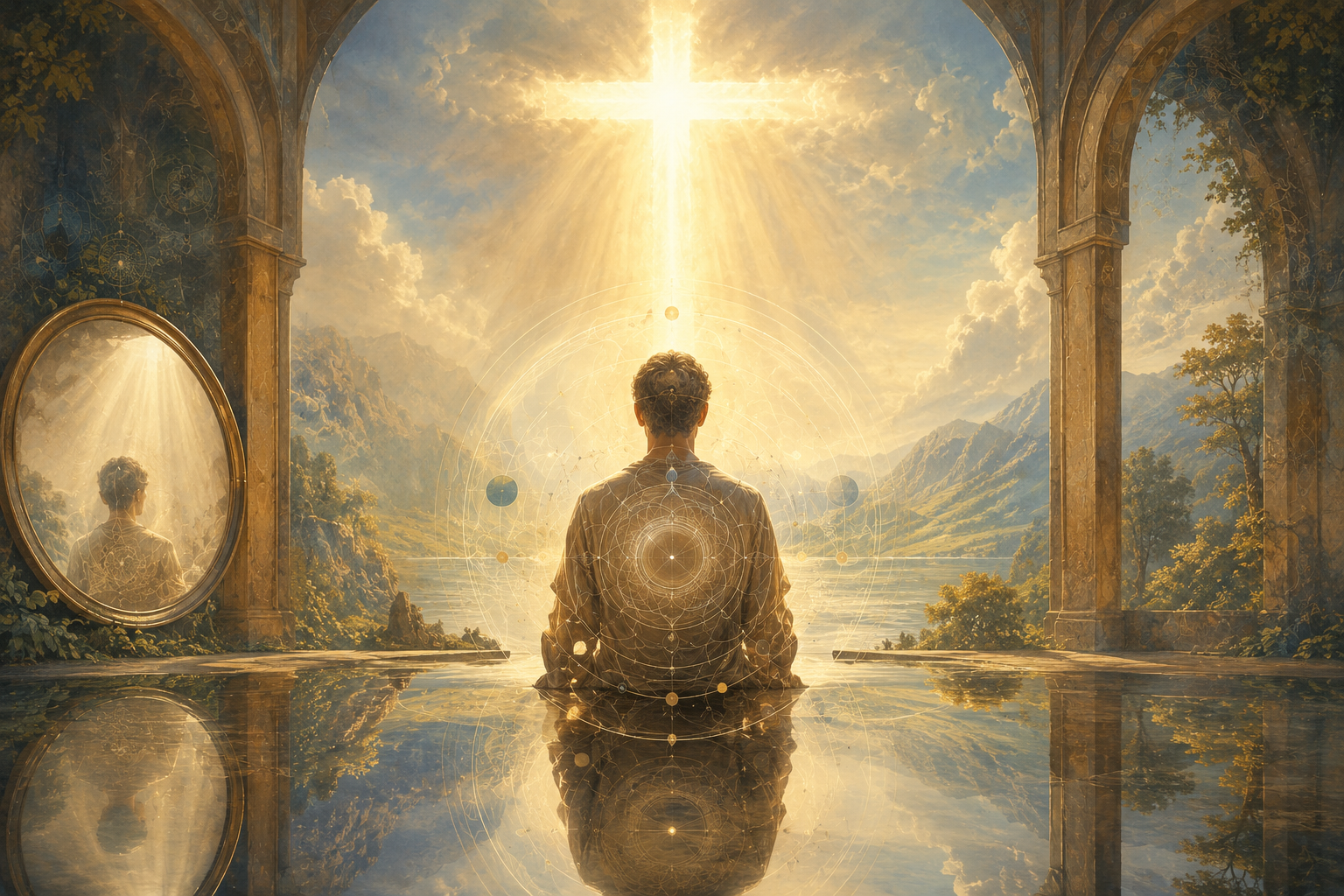
At first glance, Carl Jung’s concept of the Self can sound surprisingly similar to the Christian doctrine that human beings are made in the image of God. Jung describes the Self as the deepest organizing center of the psyche and associates it with wholeness, while Christianity teaches that something about human identity reflects the Creator. Jung also wrote extensively about religious symbols and sometimes connected the Self with the psychological image of God.
The similarities are real enough to make comparison worthwhile. Yet Christians should resist the temptation to treat the Jungian Self and the biblical imago Dei as two names for the same reality. They begin with different assumptions, answer different questions, and ultimately point beyond themselves in different ways.
Understanding the distinction can also open a productive conversation between depth psychology and Christian theology.
What Is the Jungian Self?
In everyday speech, the word self usually means the person we consciously experience ourselves to be. Jung uses the term much more precisely.
For Jung, the conscious “I” is the ego. The Self is larger. It represents the totality and organizing center of the whole psyche, encompassing both conscious and unconscious life. The ego therefore does not equal the Self. Ideally, it learns to exist in a healthier relationship with this greater psychic whole.
This relationship becomes important in Jung’s account of individuation. Individuation does not simply mean becoming more independent or expressing whatever one feels. It involves confronting neglected or rejected aspects of the personality and moving toward greater psychological integration.
This is one reason Jung’s work attracts Christians interested in spiritual formation. His psychology takes the hidden dimensions of human life seriously. It asks us to consider what happens when fear, anger, wounds, desires, or other unwanted parts of ourselves disappear from conscious awareness but continue to influence us.
What Does It Mean to Be Made in the Image of God?
The biblical idea of the image of God begins in Genesis:
“So God created man in his own image, in the image of God he created him; male and female he created them.”
— Genesis 1:27 (ESV)
The imago Dei is first a theological claim, not a psychological theory. Humanity receives its identity from God. We are creatures, yet God created human beings with a distinctive dignity and vocation within creation.
Genesis connects this image with humanity’s responsibility to exercise stewardship over the created world (Genesis 1:26-28). Other passages protect human life on the basis of that divine image (Genesis 9:6), while James condemns cursing people because they are “made in the likeness of God” (James 3:9).
The image of God therefore does not belong only to psychologically mature people. It is not an achievement reached through sufficient inner development. It belongs to human beings because of God’s creative act.
That marks an important difference from Jungian individuation.
Why the Jungian Self Is Not the Imago Dei
The fundamental distinction concerns where each concept points.
The Jungian Self describes a reality within the structure of the human psyche. The biblical image of God describes humanity in relation to a Creator who exists independently of the human psyche.
Scripture does not portray God as the deepest layer of ourselves. It distinguishes Creator from creature:
“Know that the LORD, he is God! It is he who made us, and we are his.”
— Psalm 100:3 (ESV)
This distinction matters. Christianity certainly encourages self-examination, but it does not teach that we reach God simply by traveling deeply enough within ourselves. God may meet us in the depths of our inner lives, but God cannot be reduced to those depths.
Likewise, the imago Dei should not be understood as a hidden divine fragment inside every person. Human beings reflect God; they are not pieces of God.
Why Jung Connected the Self With the God-Image
The comparison becomes more complicated because Jung himself closely connected the Self with religious imagery.
From a Jungian perspective, images of divine unity and transcendence can emerge from the psyche as symbols of psychic totality. Jung was particularly interested in mandalas and other symbols that unite opposites around a center. He also treated Christ as an especially important symbol of the Self within the Western psyche.
Here Christians need to make another careful distinction.
Jung approached Christ psychologically. Christianity makes a much larger claim. For Christian faith, Jesus Christ is not merely an image arising from the human unconscious or a symbol of psychological wholeness. He is the incarnate Son of God and “the image of the invisible God” (Colossians 1:15).
Psychology can ask what the image of Christ does within the psyche. Theology asks who Christ actually is. Those are related questions, but they are not identical.
Jung’s psychological description therefore does not by itself prove or disprove the Christian claim. Psychology can study human experience of God without possessing the tools to settle God’s objective existence.
Individuation Is Not the Same as Sanctification
The difference becomes especially clear when we compare Jungian individuation with Christian sanctification.
Individuation seeks a more integrated relationship among the various dimensions of the personality. Christianity also values truthfulness about the whole person. Scripture offers little support for a spirituality based on pretending that our darker impulses do not exist.
David prays:
“Search me, O God, and know my heart! Try me and know my thoughts! And see if there be any grievous way in me, and lead me in the way everlasting!”
— Psalm 139:23-24 (ESV)
That prayer invites examination rather than denial. First John likewise warns, “If we say we have no sin, we deceive ourselves” (1 John 1:8). Christian confession requires us to acknowledge realities that we might prefer to hide.
Jung can help Christians recognize how easily rejected parts of the personality can slip outside conscious awareness. His concept of the shadow gives us useful psychological language for exploring that process.
Yet sanctification has a different goal from psychological integration alone. The Christian standard is Christ:
“For those whom he foreknew he also predestined to be conformed to the image of his Son.”
— Romans 8:29 (ESV)
Christian transformation therefore involves more than becoming conscious of everything within us or achieving an inner balance. It includes repentance, grace, communion with God, and transformation into Christlikeness.
Wholeness may serve holiness, but the two concepts cannot simply be collapsed into one another.
Can Jung Still Help Christians Understand Themselves?
Yes, provided that psychology remains psychology and theology remains theology.
One of Jung’s most valuable insights for Christian spiritual life is his insistence that ignored parts of the psyche do not simply vanish. A person can construct a consciously “Christian” identity while refusing to acknowledge anger, pride, doubt, resentment, sexuality, grief, or fear. Those realities may then find less healthy ways to express themselves.
Christianity already possesses theological categories such as sin, confession, repentance, and renewal. Jung does not replace them. He can, however, help us notice psychological processes that complicate the ways we experience them.
The shadow, for example, is not identical to the Christian doctrine of sin. It includes morally troubling material, but it can also contain healthy qualities that a person learned to reject. Someone taught that anger is always sinful may push legitimate anger into the shadow. Someone taught that humility means passivity may suppress courage and assertiveness. Bringing those qualities into awareness does not necessarily mean surrendering to them. It allows them to be examined honestly before God.
That kind of honesty can support Christian formation.

The Self May Point Toward a Question It Cannot Answer
The most fruitful Christian engagement with Jung may lie precisely at the boundary between psychology and theology.
Jung shows how deeply the human psyche seems oriented toward images of unity, transcendence, death, rebirth, and transformation. A psychologist can examine these patterns and ask what role they play in human development.
Christian theology can then ask another question: What if the human longing for transcendence points beyond the psyche itself?
Christianity answers that our deepest identity does not finally come from discovering an autonomous inner Self. It comes from the God whose image we bear and from the restoration of that image in Christ.
Paul describes Christian renewal as putting on “the new self, which is being renewed in knowledge after the image of its creator” (Colossians 3:10).
That verse offers an intriguing meeting place for Jung and Christian theology. Christianity does call us toward a fuller and transformed humanity. Yet the source and goal of that transformation lie beyond the individual psyche. We become more fully ourselves not by making the Self divine, but by living in restored relationship with the God who created us.
The Jungian Self and the imago Dei are therefore not the same concept. Jung helps us explore the hidden structure and movement of the psyche. Scripture tells us whose image the whole person bears.
For Christians interested in depth psychology, we do not have to choose between taking Jung seriously and maintaining theological distinctions. We can allow Jung to illuminate the depths of human experience while allowing Scripture to tell us what those depths ultimately mean.