
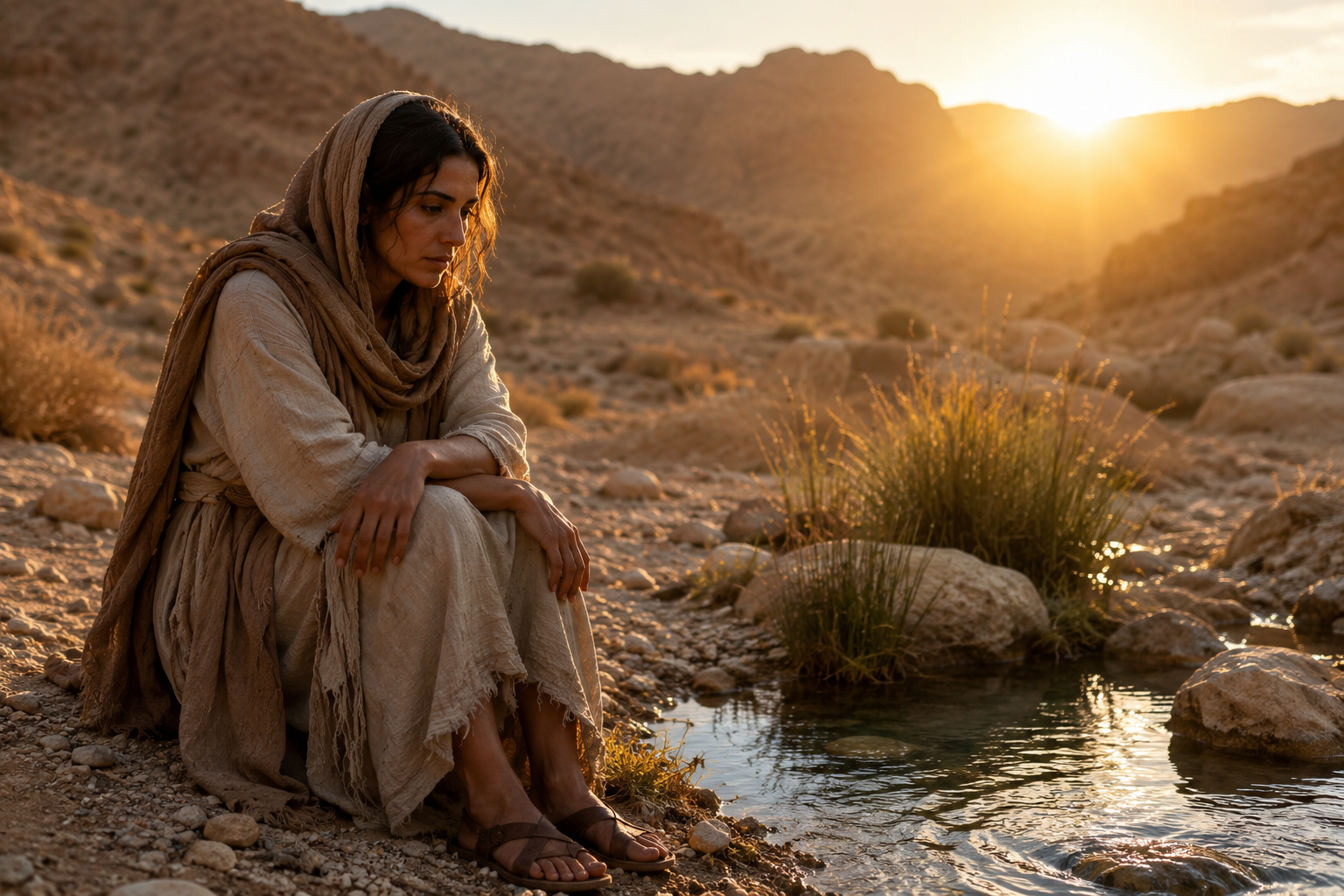
Genesis 16:7–14 gives us one of Scripture’s most arresting encounters with God. Hagar is alone in the wilderness, displaced, exhausted, and vulnerable. She has been used, mistreated, and pushed to the margins of a household built on promises that do not seem to include her. And there, far from safety and status, the angel of the Lord finds her by a spring on the way to Shur.
The turning point in the story is not that all of Hagar’s circumstances immediately improve. It is that she is seen.
This is what makes the passage so powerful for Lectio Divina. We come to Scripture looking for God, and sometimes we discover that the deeper truth is this: God has already found us. Before we have clarity, before we have strength, before we know how to pray well, God attends to us. Divine attention comes first.
Hagar’s story invites us to slow down long enough to receive that attention.
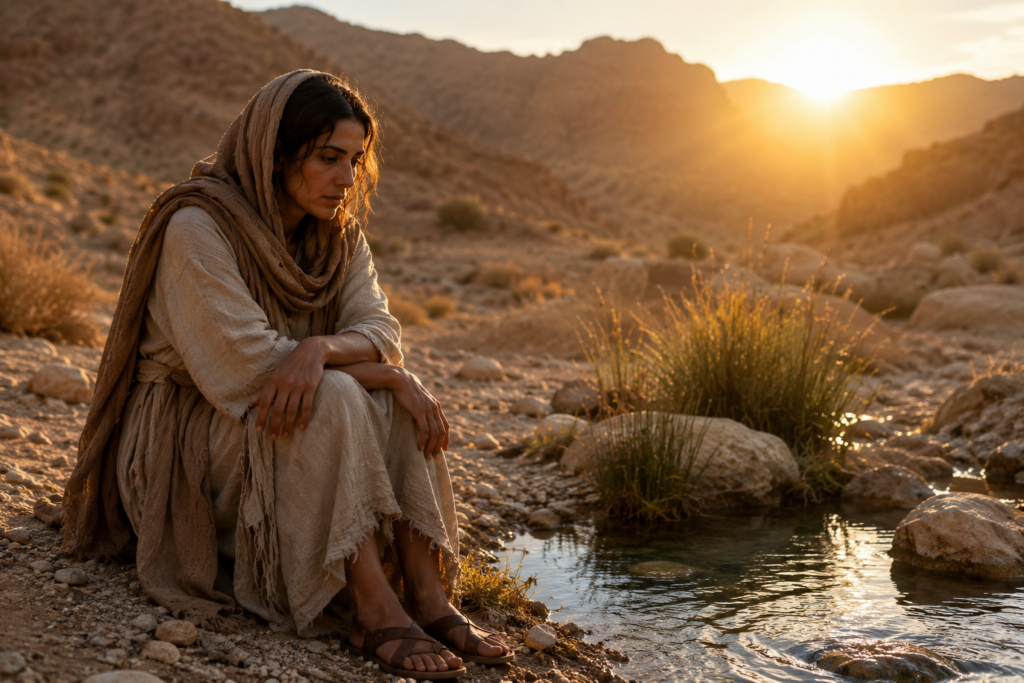
Hagar in the Wilderness
The wilderness in Scripture is often more than a location. It is a place of exposure, testing, and encounter. Israel will know the wilderness. Elijah will know it. John the Baptist will know it. Even our Lord will enter it.
Hagar knows it here as a place of weariness and uncertainty.
She is not standing in a temple. She is not participating in a formal act of worship. And she is not presented as spiritually triumphant. She is simply there, fleeing into the harshness beyond the household that has wounded her.
And that is where God meets her.
This matters because many Christians quietly assume that God speaks most clearly in moments of peace, order, and spiritual composure. But Genesis 16 reminds us that God is not limited to calm seasons. He speaks in disruption. He meets us in confusion. And He comes near in places we would not have chosen.
For those practicing Lectio Divina, this changes the tone of prayer. We do not need ideal conditions to begin. We do not need to wait until our inner life feels settled and articulate. And we may come to the text tired, distracted, carrying grief or uncertainty. The God who found Hagar in the wilderness has not lost his habit of meeting people there.
The Difference Between Visibility and Being Seen
Our age has many forms of visibility.
A person can be visible online, at work, in ministry, in a room, and still feel profoundly unseen. Recognition is not the same as being known. Public attention is not the same as love. Productivity is not the same as presence.
Hagar was certainly visible in Abraham’s household. Others saw her usefulness. Others reacted to her place in the family’s conflict. But visibility did not protect her from being treated as expendable.
Then God addresses her personally: “Hagar, servant of Sarai.”
The detail matters. God names her. He knows her story. He asks, “Where have you come from and where are you going?” This is not the question of someone gathering data they lack. It is the question of divine attention. God draws her into truthful speech. He gives dignity to her experience by receiving it.
This is one reason the passage lends itself so naturally to slow, prayerful reading. Lectio Divina is not a race to extract information. It is a way of sitting beneath God’s gaze through the words of Scripture. As we read, we learn again that God’s attention is neither hurried nor superficial. He sees persons, not just problems. He receives truth before he gives instruction.
Honest Prayer Begins with Honest Speech
Hagar’s answer is direct: “I am fleeing from my mistress Sarai.”
She does not decorate her pain. She does not offer polished language. And she tells the truth.
There is wisdom here for anyone who wants to pray but feels unsure how. We often imagine that faithful prayer must sound elevated or composed. Yet Hagar’s encounter shows that truthful prayer begins with naming reality. She tells God what is happening. She says where she is in the story.
This is one of the quiet gifts of Lectio Divina. As we linger with Scripture, we often become more honest. A phrase in the text exposes fear, grief, resentment, loneliness, or longing that we have kept partially hidden even from ourselves. Prayer then begins not in spiritual performance but in truthful presence.
To read slowly is to make room for this honesty.
A short passage like Genesis 16:7–14 can be read several times. On the first reading, you may notice the setting. On the second, you may find yourself resting on the fact that God asks questions. And on the third, you may recognize that you have been avoiding your own truthful answer about where you have come from and where you are going.
That, too, is grace.
The angel of the LORD found her by a spring of water in the wilderness, the spring on the way to Shur. And he said, “Hagar, servant of Sarai, where have you come from and where are you going?” She said, “I am fleeing from my mistress Sarai.” The angel of the LORD said to her, “Return to your mistress and submit to her.” The angel of the LORD also said to her, “I will surely multiply your offspring so that they cannot be numbered for multitude.” And the angel of the LORD said to her,
“Behold, you are pregnant
and shall bear a son.
You shall call his name Ishmael,
because the LORD has listened to your affliction.
He shall be a wild donkey of a man,
his hand against everyone
and everyone’s hand against him,
and he shall dwell over against all his kinsmen.”
So she called the name of the LORD who spoke to her, “You are a God of seeing,” for she said, “Truly here I have seen him who looks after me.” Therefore the well was called Beer-lahai-roi; it lies between Kadesh and Bered. (ESV)
The First Woman to Name God
One of the most striking features of this passage is that Hagar names God. She calls him “You are a God of seeing,” or, as many render the sense, “the God who sees me.”
This is a remarkable honor in the biblical narrative.
Hagar is not the powerful figure in the story. She is an Egyptian servant, a woman without social protection, caught in the fallout of decisions made by others. And yet she becomes the one who speaks one of Scripture’s most memorable names for God.
That should shape the church’s imagination.
God’s self-disclosure is not restricted to those the world assumes are central. Again and again in Scripture, the Lord shows particular concern for the outsider, the afflicted, the overlooked. This does not romanticize suffering. It does reveal the freedom and mercy of God. He is not impressed by social rank. He is attentive to the cry of the vulnerable.
Hagar’s naming of God also shows that encounter can lead to language. Contemplation is not silence in opposition to speech; it is often silence that ripens into true speech. After being seen by God, Hagar is able to say something true about God.
That is what contemplative reading can do in us. It trains our attention until our language becomes more faithful, more careful, and more rooted in reality.
Divine Attention Changes Human Attention
If God’s first movement toward Hagar is attention, then our response should involve learning to attend as he does.
We become, in part, what we repeatedly contemplate. A distracted life produces distracted love. A hurried heart rarely notices who is suffering nearby. But when we let Scripture slow us down, when we receive the patient gaze of God, our own habits of attention can begin to change.
This is not only inward. It is ethical.
To be seen by God should make us more capable of seeing others. Not sizing them up, not fixing them quickly, not reducing them to their usefulness or their difficulty, but actually seeing them.
God does not begin by solving everything in Hagar’s life at once. He first addresses her. He acknowledges her. Presence precedes resolution.
That is an important lesson for many of us. We often rush to advice when witness is needed first. We hurry to repair before we have listened. But attention is an act of love. To give another person undivided presence, even briefly, is no small thing.
This is where today’s passage reaches beyond private devotion. If Lectio Divina trains us to receive God’s attention, it also trains us to offer a sanctified form of attention in the world.
Practicing Lectio Divina with Genesis 16:7–14
As you read this passage, do not rush toward a lesson. Stay with the scene.
Notice the wilderness. Notice the spring. And notice that Hagar is found. Notice that God asks questions. Notice the dignity of being addressed by name. And notice the words, “You are a God of seeing.”
Read the text slowly two or three times.
Then rest with a single phrase. Perhaps it is “the angel of the Lord found her.” Perhaps it is “Where have you come from?” Perhaps it is “You are a God of seeing.”
Let that phrase remain with you.
If you feel forgotten, do not force yourself into cheerful conclusions. Let the passage do its work gently. The point is not to manufacture a spiritual feeling. It is to stay present long enough to receive what God may be giving through the text.
For some readers, the most important realization today may simply be this: I do not need to find God before I may be known by God. He has already turned his attention toward me in mercy.
And from that place, a further invitation may come: offer one act of attention that requires nothing in return.
It may be listening carefully to someone without interrupting. It may be noticing a person everyone else passes by. Or it may be acknowledging your own hidden wound before God without judgment. It may be pausing long enough to recognize grace in an ordinary hour.
Readers who would like a complete year of daily Lectio Divina Scripture readings, guided reflections, writing prompts, prayers, and contemplative practices can continue their journey through The Morning Scriptorium: 365 Days of Lectio Divina and Contemplative Writing.
Or, the online course: https://teachclub.com/@morning_scriptorium
A Closing Prayer
God who sees,
find us again in the places where we feel overlooked, tired, or unsure.
Teach us to receive your attention without fear and to offer that same gentle presence to others.
Make us truthful in prayer, patient in listening, and faithful in love.
Amen.
Reflection Questions
- Which word or phrase in Genesis 16:7–14 draws your attention most strongly today?
- Where in your life do you most need to remember that being seen by God is different from merely being visible to others?
- What is one act of attention you can offer today that requires nothing in return?
Return Tomorrow
Return tomorrow for the next day’s Lectio Divina reading, and continue the slow work of learning to live in the presence of the God who sees.