Why this question matters
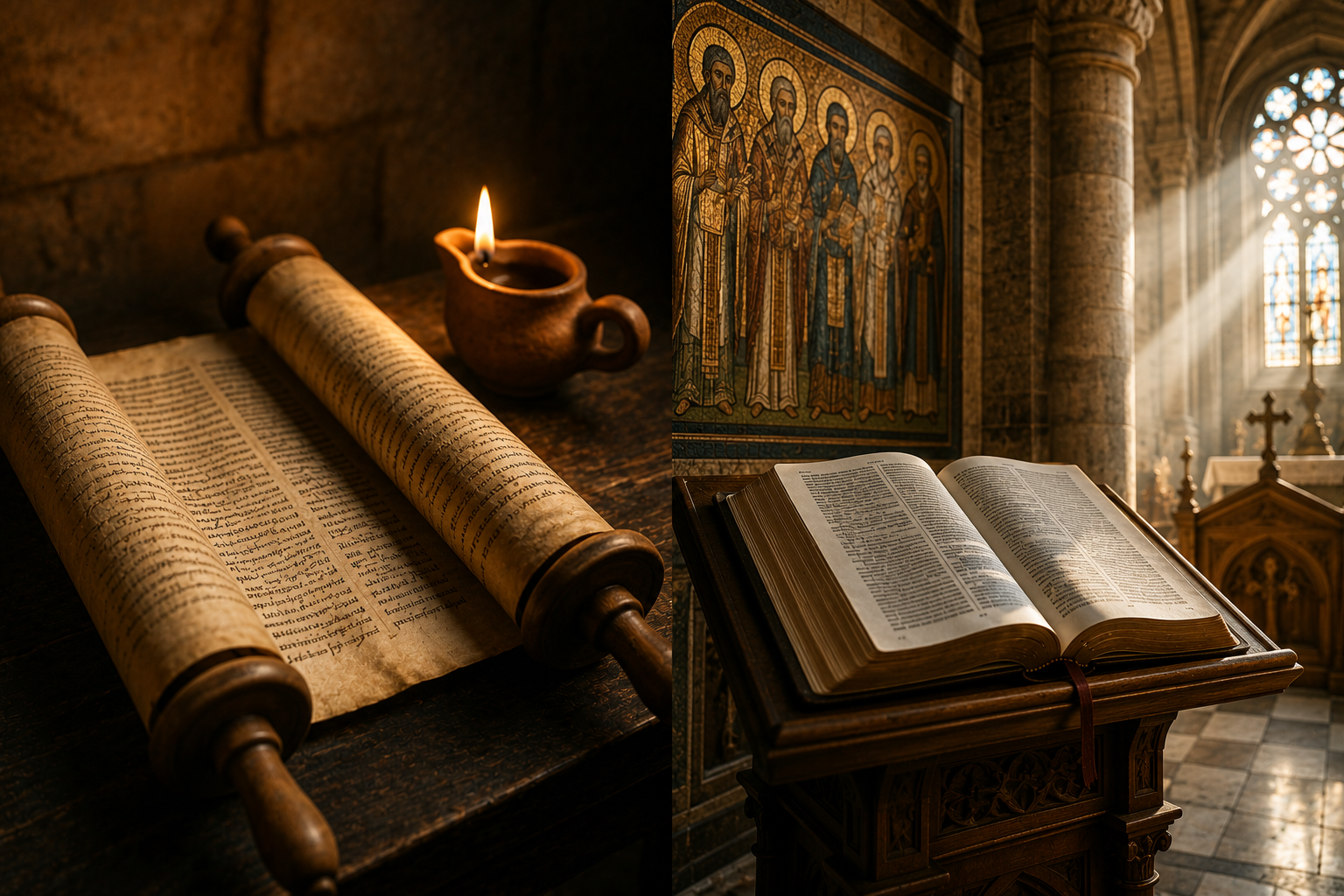
Few questions are more important for theological study than the relationship between Scripture and tradition. Christians confess Holy Scripture as the unique and normative witness to God’s revelation, yet the church has never read Scripture in isolation from its worship, teaching, creeds, and inherited patterns of interpretation. To ask how Scripture and tradition belong together is therefore to ask how Christian doctrine is received, tested, taught, and handed on across generations.
In serious theological education, this question cannot be reduced to a simple opposition between the Bible and the church. Scripture is the church’s book, given by God and received within the community of faith. Tradition, at its best, is not a rival authority standing over Scripture, but the ongoing life of confession, interpretation, and discipleship shaped by Scripture. The task of theology is to understand this relationship carefully so that Christian belief remains both faithful to the apostolic witness and attentive to the wisdom of the historic church.

Scripture as the norm of theology
Christian theology begins with the conviction that Scripture is the primary norm for doctrine. The prophets and apostles bear authoritative witness to God’s saving work, and the church is continually called back to that witness. Theology does not invent its subject matter. It receives the biblical testimony, studies it with care, and seeks to articulate its truth with clarity and reverence.
This means that doctrine must always be accountable to Scripture. Every theological formulation, every confessional statement, and every inherited practice must be tested by the canonical texts. The church does not stand above Scripture as its master. Rather, the church stands under Scripture as a people addressed, corrected, and renewed by the Word of God.
Tradition as the church’s memory
At the same time, Christians do not approach Scripture as if no one has read it before. The church’s tradition preserves a living memory of how believers across centuries have confessed the triune God, defended the faith against error, and learned to read the Bible within the rule of faith. Creeds, councils, catechisms, liturgies, and theological writings all belong to this broader inheritance.
Tradition serves theology by offering continuity, vocabulary, and judgment. It helps the church name central doctrines such as the Trinity and the incarnation with precision. It guards against private interpretation detached from the communion of saints. It also reminds modern readers that theological insight is not confined to the present moment. To study theology well is to listen not only to the biblical text but also to the long history of Christian reflection shaped by that text.
Avoiding false alternatives
Much confusion arises when Scripture and tradition are treated as enemies. If Scripture is isolated from the church’s interpretive life, readers may imagine that faithful theology requires no historical awareness, no doctrinal discipline, and no conversation with earlier generations. The result is often shallow interpretation and doctrinal instability. On the other hand, if tradition is treated as an independent source that cannot be corrected by Scripture, theology risks becoming rigid, self-protective, and inattentive to the biblical witness.
A more faithful approach recognizes a proper order. Scripture is the supreme norm because it bears the foundational apostolic and prophetic witness. Tradition is ministerial rather than magisterial: it serves the church by preserving, clarifying, and transmitting what Scripture teaches. In this way, tradition is neither dismissed nor absolutized. It is honored as a necessary dimension of the church’s life under the authority of God’s Word.
Why this matters for students
For students of theology, the relationship between Scripture and tradition shapes the entire practice of study. It encourages close reading of biblical texts while also cultivating humility before the church’s inherited wisdom. It teaches students to ask not only, “What does this passage say?” but also, “How has the church understood this doctrine, and why did these formulations matter?” Such questions deepen theological judgment and protect against both novelty and reductionism.
- Read Scripture as the church’s foundational authority.
- Use creeds and confessions as guides to faithful interpretation.
- Learn from major theologians without treating them as infallible.
- Test inherited formulations by the biblical witness.
- Pursue doctrine as a form of disciplined ecclesial learning.
When students learn to hold Scripture and tradition together in their proper relation, they are better equipped for mature theological work. They can appreciate the depth of Christian doctrine, understand the historical development of key teachings, and participate more responsibly in the church’s ongoing task of confession and instruction.
Theology is strengthened when Scripture remains the norm and tradition remains the church’s faithful memory.
A path toward deeper study
Questions about Scripture, doctrine, and the church’s interpretive tradition belong at the heart of Christian education. They require patience, historical awareness, and a willingness to think carefully about how the faith has been taught and confessed. For independent learners seeking rigorous formation, these are not secondary concerns. They are central to the work of theological understanding.
If you want to build a stronger foundation for studying doctrine, biblical interpretation, and the central claims of the Christian faith, begin with a course designed to introduce theology in a clear and structured way.