The laws of the Torah can feel restrictive to modern readers. They govern worship, food, work, sexuality, agriculture, property, courts, festivals, and family life. Some commands also come from a culture far removed from our own. When readers encounter this level of detail, they may see little more than an ancient religious code built around prohibitions.
The Torah, however, tells a different story about its purpose. It presents God’s law as instruction for a people whom God has already rescued. These commands teach Israel how to live in covenant with God and with one another. They set boundaries, but those boundaries protect worship, justice, community, and life.
For this reason, we should not treat restriction and flourishing as complete opposites. Good boundaries often make flourishing possible. The Torah aims to form a people who love God, practice justice, protect their neighbors, and reflect God’s holiness in ordinary life.
Torah Means More Than “Law”
English Bibles often translate torah as “law,” but the Hebrew word also carries the sense of instruction or teaching. That wider meaning helps us understand the Torah’s purpose. God does not merely issue legal demands. He teaches his covenant people how to order their lives around his character and purposes.
Moses describes the choice before Israel in striking terms:
“See, I have set before you today life and good, death and evil” (Deuteronomy 30:15, ESV).
The commandments mark a way of life. Israel’s obedience expresses trust in the God who delivered the nation from slavery. Disobedience pulls the people toward injustice, idolatry, disorder, and death.
Psalm 19 celebrates this life-giving quality of divine instruction: “The law of the LORD is perfect, reviving the soul” (Psalm 19:7, ESV). Psalm 119 likewise treats God’s commands as sources of wisdom, freedom, hope, and delight. These writers do not describe the Torah as a burden imposed by a hostile ruler. They describe it as a gift from a faithful God.
Grace Comes Before the Commandments
The order of the biblical story matters. God did not give Israel the commandments so that the people could earn rescue from Egypt. He rescued them first.
The Ten Commandments begin with a reminder of grace: “I am the LORD your God, who brought you out of the land of Egypt, out of the house of slavery” (Exodus 20:2, ESV). Only then does God tell Israel how to live.
This pattern prevents us from reducing the Torah to a system of religious achievement. God acts, saves, and establishes a relationship with his people. The law then teaches that redeemed community how to respond. Obedience does not purchase God’s love. It gives covenant faithfulness a visible shape.
The commands concerning worship, rest, property, truthfulness, sexuality, and family life all grow from this relationship. Israel belongs to God, so Israel must not imitate the destructive practices of surrounding nations. The people must display a different kind of communal life.
The Torah Protects the Vulnerable
Some of the clearest connections between the Torah and human flourishing appear in its concern for vulnerable people. The law repeatedly addresses the treatment of the poor, widows, orphans, foreigners, laborers, and debtors.
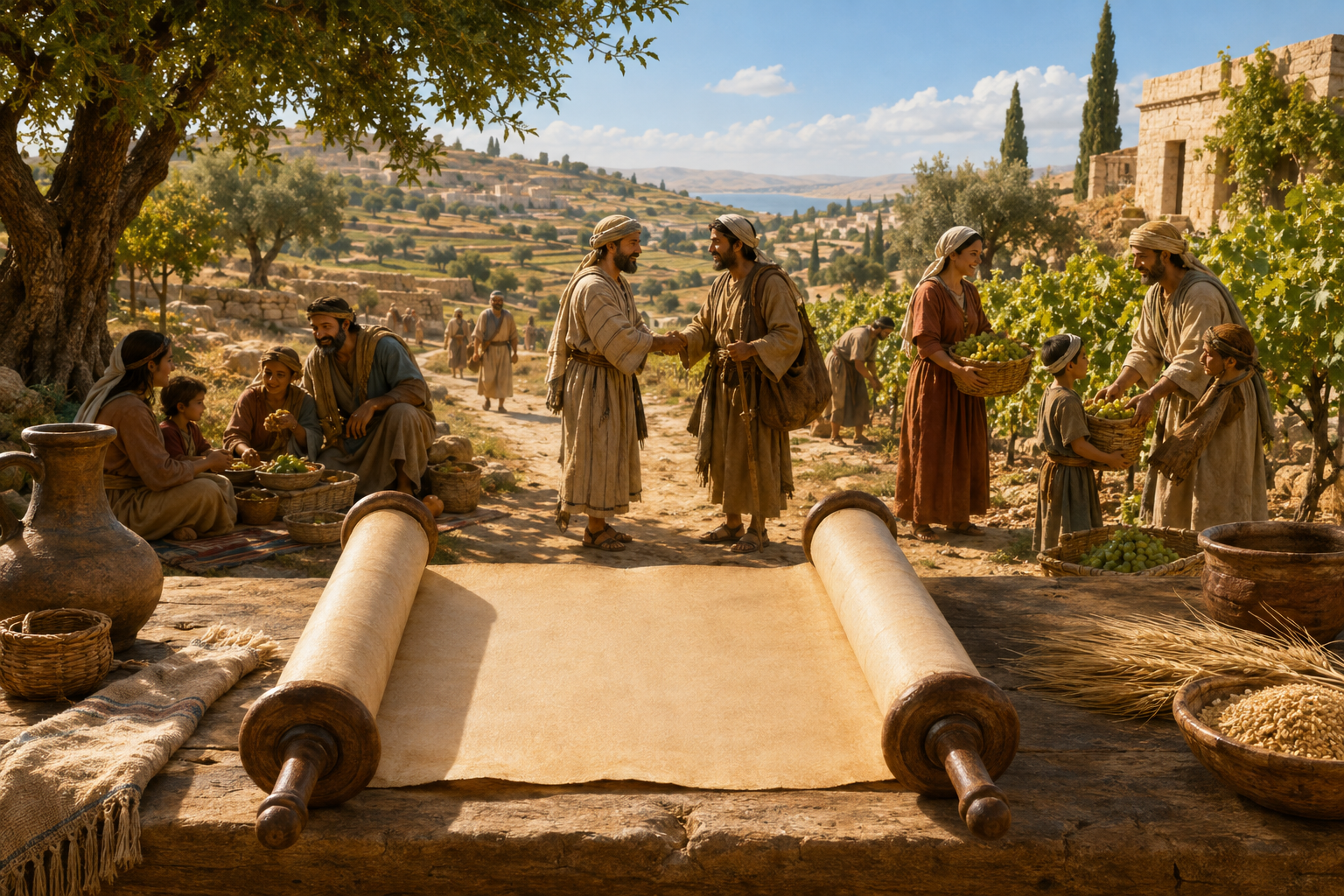
Farmers could not harvest every corner of their fields. They had to leave part of the crop for the poor and the sojourner (Leviticus 19:9–10). Employers had to pay poor workers promptly because those workers depended upon their wages (Deuteronomy 24:14–15). Judges could not distort justice to favor either the poor or the powerful (Leviticus 19:15). Israelites had to return lost property and even help an enemy’s animal when it struggled under a burden (Exodus 23:4–5).
These laws reject the idea that property rights erase responsibility to one’s neighbor. They also refuse to separate private morality from social justice. A faithful Israelite could not claim devotion to God while exploiting workers, manipulating courts, or ignoring hungry families.
The Torah places moral limits on power. Landowners, employers, judges, lenders, and household leaders all answer to God. Flourishing, in this vision, does not belong only to the wealthy or socially secure. A just community makes room for people who possess less power.
Holiness Enters Everyday Life
The Torah does not confine faith to worship services or private belief. It brings holiness into meals, business agreements, farming practices, sexual conduct, family relationships, and care for animals. Every part of life comes under God’s concern.
Leviticus gives the central principle: “You shall be holy, for I the LORD your God am holy” (Leviticus 19:2, ESV). The chapter then connects holiness with honoring parents, rejecting idols, leaving food for the poor, paying workers fairly, judging honestly, and loving one’s neighbor.
This pattern reveals something important. Biblical holiness does not mean withdrawal from human needs. Holiness takes concrete form through faithful worship and ethical action. It affects how people use money, speak about others, exercise authority, and respond to weakness.
The Torah therefore trains Israel to see ordinary decisions as spiritually significant. Human flourishing involves more than personal comfort. It includes right relationship with God, integrity within oneself, justice toward others, and responsible care for the created world.

Restrictions Can Protect What Is Good
Modern culture often defines freedom as the absence of limits. Scripture offers a more careful account. Some desires lead toward life, while others damage the self and the community. Freedom requires more than permission to do whatever we want.
A guardrail restricts a driver, but it also keeps the vehicle from leaving the road. In a similar way, the Torah restricts idolatry, exploitation, violence, dishonesty, sexual wrongdoing, and neglect of lower-income people because these practices destroy trust and fracture communities.
Of course, human beings can misuse any legal system. Religious leaders can focus on technical compliance while neglecting mercy. The prophets repeatedly confronted Israel for that failure. Isaiah condemned worship that coexisted with injustice and called the people to “seek justice” and “correct oppression” (Isaiah 1:17, ESV). Micah summarized covenant faithfulness through justice, kindness, and humble fellowship with God (Micah 6:8).
The problem did not lie in God’s desire for holiness and justice. The problem lay in hearts that performed religious acts while resisting the purpose of God’s instruction.
How Should Christians Read the Torah?
Christians should neither discard the Torah nor transfer every command directly into modern life. God gave the Mosaic law to ancient Israel within a particular covenant. That covenant included a priesthood, sacrifices, purity practices, civil judgments, land promises, and national institutions.
Jesus fulfills the Law and the Prophets rather than abolishing them (Matthew 5:17). His life, death, and resurrection bring the Torah’s story and sacrificial patterns to their intended goal. Hebrews explains that Christ offered the decisive sacrifice for sin “once for all” (Hebrews 10:10, ESV). Acts 15 also shows that the early church did not require Gentile believers to enter the Mosaic covenant as Jewish proselytes.
Yet fulfillment does not make the Torah worthless. The Torah reveals God’s holiness, exposes human sin, displays the shape of covenant faithfulness, and teaches enduring principles of justice and mercy. Christians read each command through its historical setting, its place in the biblical story, and its fulfillment in Christ.
Jesus gives us the central interpretive lens. He names love for God and love for one’s neighbor as the two greatest commandments. “On these two commandments depend all the Law and the Prophets” (Matthew 22:40, ESV). Paul echoes this truth when he writes, “love is the fulfilling of the law” (Romans 13:10, ESV).
Love does not replace moral seriousness with vague kindness. Biblical love seeks the genuine good of God and neighbor. It practices truth, justice, faithfulness, mercy, and self-restraint.
A Path Toward Covenant Flourishing
The Torah contains real restrictions. It tells people that some actions lead away from God’s purposes and toward harm. Yet those limits serve a larger vision. God desires a people who worship faithfully, judge fairly, work honestly, rest regularly, protect the vulnerable, and treat their neighbors with dignity.
The Torah’s vision of flourishing also challenges individualism. Scripture does not define the good life as personal success without obligation to others. My choices affect my family, my neighbor, the stranger, lower-income people, and the wider community. Flourishing requires relationships ordered by love and justice.
When we read the Torah within its covenant setting and the whole biblical story, we find more than a restrictive code. We find divine instruction that directs human life toward holiness, wisdom, mercy, and communion with God. Its deepest aim does not consist in rule keeping for its own sake. It seeks to form a people whose shared life bears witness to the goodness of God.
That vision still speaks powerfully today. The Torah invites us to ask not only, “What am I forbidden to do?” but also, “What kind of person and community does God call us to become?”